Find the podcast feed and the most recent episode below.
Sign up to the newsletter to get new podcast episodes in your inbox.

SBD Mythbusting: Common Misconceptions about Squat, Bench, and Deadlift with Tristan Jacobs – Total Performance with Siobhan Milner
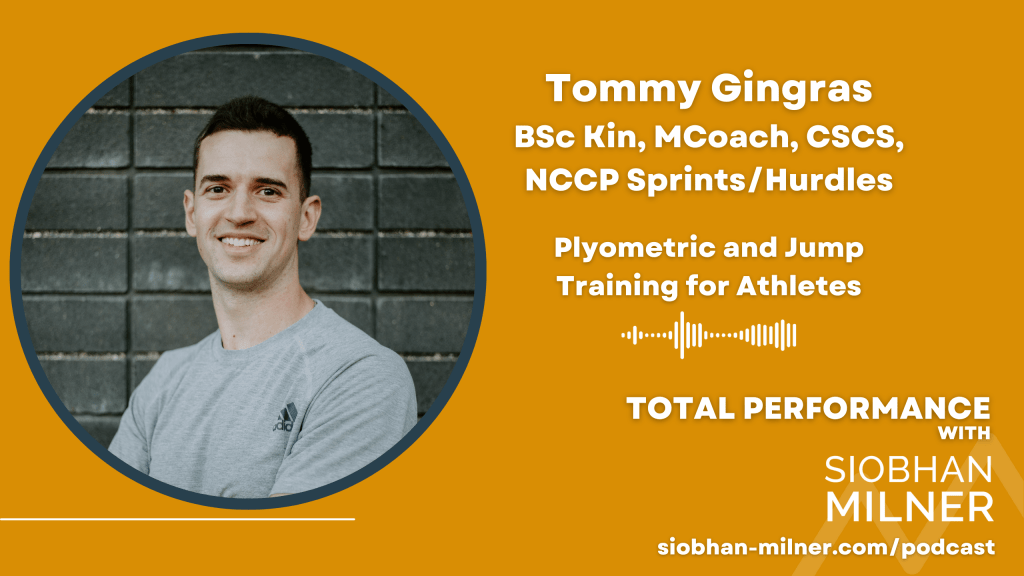
In this podcast, Siobhan Milner chats to Tommy Gingras about jump training and plyometric training for athletes. They clarify the difference between the two- because they are different! Tommy also talks about assessing athletes’ jumping styles, and how that may influence how we train. He advocates for a balanced approach to strength and power training, emphasizing the need to build a strong foundation before focusing on explosive capabilities. Tommy and Siobhan also touch on how training can change as the competitive season unfolds, and how training strategies should adapt to athletes’ experiences and demands. Tommy highlights that even athletes in non-jumping sports can enhance their performance through plyometric training, and gives some tips for how to incorporate plyometric and jump training into an athlete’s schedule.
Find it everywhere you get your favourite podcasts.
Thoughts about this episode? Let me know over on IG!
About Tommy Gingras:
Tommy Gingras is currently the lead strength coach and assistant sprints coach for the University of Guelph track and field team in Canada. His time as an athlete encouraged him to pursue a career in coaching. Following his undergrad in kinesiology, he primarily worked with team sports in a strength and conditioning capacity. Tommy completed his master’s in sport conditioning and during this time began coaching athletics. Since that time Tommy has been in a role blending on track and weight room coaching for the athletes he works with. In his current position he provides weight room programming across all event areas on the team.
Featured on the show:
Where to find Tommy:
Instagram: @speedstrengthperformance
Important Links:
- Stay up to date on the Total Performance podcast where you can join Siobhan Milner and guests as we explore the many aspects that come together to build our total performance.
- Find Siobhan Milner on Instagram, Twitter, & Facebook
Transcript for Plyometric and Jump Training for Athletes with Tommy Gingras, BSc, MCoach, CSCS
Tommy Podcast
Siobhan Milner: [00:00:00] Welcome, Tommy.
How you doing?
Tommy Gingras: I’m good. How are you?
Siobhan Milner: Yeah, I’m good. As I said, I’ve been traveling a little bit for work, so I’m a little tired, but I’m excited to be chatting with you today.
Tommy Gingras: Oh, and I, thanks for having me on. I always. Always love to be on different things like this and have the chance to interact and, you know, connect with other coaches and sport practitioners from around the world.
So it’s, it’s always a fun time. So thank you for having me and I’m excited to be here.
Siobhan Milner: Oh, you’re very welcome. So we’re going to talk a little bit about jump training today and also plyometrics. So do you mind starting us off? Because I know when I speak to athletes, but also coaches they have an idea.
Of what they think jump training is or how you might train for jumping. And often when I say the word plyometrics, they don’t actually realize that this could be something different to just jumps in general. So can you talk a little bit about the difference between the two?
Tommy Gingras: Yeah. So for me, especially coming from a kind of blended strength [00:01:00] and track and field background, when I think of plyometrics, I think of.
Verk Shansky and all the work that went on in the sixties Russian high jump coach and the, they use this plyometric training cause that was the term that they, they coined it was an alternative to sports specific training. Cause at certain times of the year, they couldn’t high jump outside or do different jump activities.
So they looked at the contact times and how long they. apply force in a high jump or a long jump or things like that. And then they tried to create or find substitutes where they would apply jump type force in that same timeframe. And so one of the big elements of that was dropping from some kind of free fall or having an element where you were free falling from a elevated surface or from a previous jump, and then having to land, interact with the ground [00:02:00] and then propel yourself.
back up. So to me, a plyometric movement has to have that free fall, interact with the ground, and then react to the ground and come, come back up or forward or whichever direction you’re jumping where jump training doesn’t necessarily have to have reactive component. I could be standing on the ground, load up, keep both feet on the ground, and then jump as high as I could to do a vertical jump test or jump onto a box.
So to me, the big difference between plyometric training and jump training in the way that I prescribe it. Is that ground contact time or that time in which you’re interacting and reacting to the ground.
Siobhan Milner: So when we’re talking about this free fall, I feel like there’s a lot of athletes that will be familiar with depth jumps and drop jumps.
But also when we’re talking plyometrics. There’s also, it’s not a free fall, but we have that same reaction when it’s just the things like the little leaps in place or little bounds and stuff like that. So [00:03:00] that would still fall into that plyometric category rather than your max height takeoff where you’re reaching for something right away.
Tommy Gingras: Yeah, in my case, yeah, because I figure whether the athlete, my guess, I don’t know for sure because it wasn’t around back then. My guess is they were doing stuff from a free fall off the boxes, knowing how the, you know, the old school, you know, Eastern block training was, All sorts of sports science based.
I’m guessing they were using the box heights to keep track of, Oh, if we fall off, come off of a two foot box or a three foot, or that way, everything was kind of tracked and measured. Where for me, I go, okay, well, whether we’re moving off of a elevated surface or whether we’re, you know, doing repetitive hurdle hops, we’re still up in the air and then coming down and interacting with the ground.
So I don’t have it down to such a. Sports science. Every training session is not a, you know, a laboratory research type thing. So, I’m guessing that’s why a lot of [00:04:00] that stuff was done off of boxes was to quantify everything but to me, a free fall movement is a is a free fall movement whether you’re, you know, coming off of a previous jump or dropping or, you know, jumping off of a box.
Siobhan Milner: And when it comes to either styles of training or combining both, if we’re doing plyometric or if we’re doing jump style training, how would an athlete decide what they wanted to incorporate or if they needed to incorporate some more of the plyos or some more of the max jump? So maybe it’s a good idea to kind of think about a case study or something.
So maybe an athlete that is really I, as you know, I’m, I’m quite interested obviously with beach volleyball, but maybe an athlete like a volleyball player who’s trying to increase their maximum jump height. And of course we’ve got things like blocking where it’s kind of from a relatively stopped position or we’ve got the spiking where they come into it.
How would an athlete decide, okay, this is what I need to look at to improve that jump height. [00:05:00]
Tommy Gingras: Yeah, so, so if I draw on some of the previous experience I had with basketball, one of the first things I noticed when I was working a lot with basketball was the style of jumping that different athletes used.
And when I got, I never played basketball growing up. I was not my sporting background is more track and field played a little bit of American football. A lot of ultimate frisbee. So sports that are not really yeah. Basketball at all. But when I was watching basketball for the first time, noticing the outside players, the guards outside of the court, making a lot more one foot movements, kind of bounding actions.
They’re coming into positions to either defend or attack the rim. With momentum going off of one foot, but then you watch some of the bigger athletes centers, the power forwards, the ones that are playing inside the paint close to the rim. They’re in a two foot position boxing out or trying to prevent the box out and then making some sort of pivot move and attacking or defending the rim off of [00:06:00] two feet.
So. And if you watch somebody do a maximal high jump with an approach, some people will take off two feet. Some people will take off of one. So one of the things I find fascinating is our people, one foot or two foot jumpers, because not all the time but typically what I’ll see what I’ve heard what I’ve seen is the one foot jumpers are.
a little more ballistic, a little more dynamic. They depend on having some momentum and then they’re very good at transferring the momentum. In this case, usually a horizontal movement or a forward action and then transforming that into a vertical movement. Or upward movement as where some of the two foot jumpers, these are usually bigger, more powerful force driven people.
And they do a really good job on two feet, loading up and almost like muscling into the jump, so to speak. They’re really powerful, really, really strong. And so [00:07:00] that was kind of my first time seeing, okay, people jumping different, cause coming from track. You jump off of one foot pretty sure in high jump, you have to take off of one foot.
They won’t allow you to take off of two. You’ll get fouled for that. And then in long jump and triple jump, you approach and take off of. Of one foot. So hadn’t really given much thought to the one foot, two foot jumping until I got into the team sport area. So to me, that would be one of the first things to you when you watch film of you playing the game or, you know, pay some attention, are you more of a one foot or a two foot jumper, because that might give you some insight onto how you need to train to better perform.
And in some cases you might need to do both. Like you said, in volleyball you know, a blocking jump, a little more two foot standing there squared up to the net, jumping and blocking on like a spike. You might have a little bit more you know, degrees of freedom or different ways that you could do it.
You, your setup might be taking off of two feet or might be taking off of, of one. So you have some. [00:08:00] Some kind of leeway there. So I don’t know if that kind of answers the question, but to me, the one foot versus two foot jumper kind of tells me the skillset that someone has and what they like to do or their, their movement preference.
And then we can train accordingly to make sure that you’re going to get better at the style of jump you either need or prefer to use.
Siobhan Milner: Yeah. I think that’s an interesting one, especially for athletes or coaches that are either just starting out or maybe don’t have access to a team to assess them and watch them as well because so if we’re saying like the one footers tend to be more reactive, more elastic, and then the two footers tend to be more strength dominant.
I wonder, how would you recommend that an athlete would decide if they Keep honing that particular skill that they’re good at, or if they go, okay, actually I need to fill in the gap because I’m more reactive. So I should work more on the strength side. Do you understand what I mean?
Tommy Gingras: Yeah, there’s [00:09:00] so, I mean, there’s, I don’t know exactly what jump tests maybe you do with your volleyball squads.
I know with basketball, kind of the traditional, you know, two foot feet glued to the ground. Load up, touch the veins or touch the wall or whatever it is you’re reaching for kind of a standard. Up down type jump, which to me again is a jump. It’s not a plyometric. So the force strength kind of created athletes will do really well in that.
And then you can have sort of an approach jump where you’re allowed to run into the jump and then take off and reach as high as you can. So looking at kind of the, the gap between, between the two, I know I’ve worked with athletes before that. You know, you load them up on two feet, they explode, they jump and touch 35 inches, and then you give them a running approach and they touch 35 inches, right?
So that tells me, okay, that person’s probably very strong, very powerful, good at creating [00:10:00] that two foot style jumping, but maybe doesn’t have the elastic or the reactive capabilities to be a, a one foot or running jumper. So maybe we have to address that. Or you get vice versa. So you have someone who’s.
You know, watch them do the counter movement jump. You know, they only hit like, you know, 20 something. That’s not very good. And then you give them a little bit of space to run into it. And all of a sudden they’re up there touching 40 inches or something like that. And they just have this ability to take off.
So that’s maybe one of the easiest or the most accessible ways to kind of look at it without, without technology is. You know, how easily can you vertically get up somewhere if you have a kind of a standing or stationary jump versus a jump with some sort of momentum or movement going into it.
Siobhan Milner: we do obviously a lot of testing ourselves and one of the things we’ll do is we’ll do Reactive strength index through things like the 10 fives, the pogo jumps.
But if we’re looking for something really accessible, I just wonder if you’ve heard of this app, I think it’s called my jump. I haven’t [00:11:00] used it, but apparently it’s free. I, yeah, I just wondered if you knew, cause I know you can just film and you can actually get ground contact times from that, so maybe that’s also something interesting
Tommy Gingras: so, I mean, that would be a super accessible way too, for people to figure out more of, you know, are you strong enough? Are you powerful enough? And then are you reactive enough? And then you figure out, do you have kind of the base level or foundational physical or athletic qualities to do what you need to do?
And then, you know, how well do you transfer those abilities? Into your call it your jump specific movements, because some of those general training things that could help you with one or two foot jumping that you do in the weight room or supplemental training could look very different than the jumping activity you do, but still have benefit.
Siobhan Milner: Yeah actually, I’d love if you would talk a little bit more about the, the weight room side as well, because I think, especially with some of the athletes I work with when they come to me and they’re in like talent development programs and things, one of the [00:12:00] things they often say to me is like, Oh, yeah, but I can’t get too strong or I can’t get too big because I need to be able to jump.
I need to be powerful. So what would you say to an athlete that said something like that? And what would your approach be in the weight room?
Tommy Gingras: Yeah, so I have a, my approach in the weight room is, I guess, a little more linear in the sense of, I work with a lot of varsity or collegiate level athletes. So kind of like you mentioned, a lot of times I’m getting first year athletes, especially in the sport of athletics or track and field, where they do a lot of the sport, but they don’t do a lot of lifting necessarily.
So I get people, like you said, they’ve never lifted. So kind of going through the continuum of, are we strong enough? Are we powerful enough? And then can we be as reactive as possible in that linear kind of fashion? And we have some, you know, some loose metrics around what is strong enough and what is powerful enough.
And then I don’t think there should, or [00:13:00] we want to have a limit on reactivity, you know, the more explosive and ballistic we can be, that’s going to make us better at our sport. So. If we can kind of achieve those things. So I don’t know if there’s such thing as too strong for your sport. But what I will say is that there’s a point of diminishing returns.
So that’s where I kind of get to the point of, are we strong enough? And for, you know, the classic back squat, I sort of live in the world of that 1. 6 to 2. 0. Times body weight squat to be sort of strong enough if you want to be power lift or strong, the amount of time and effort you would have to put in to creating a three times body weight squat probably isn’t worth it because you should be spending more time.
Becoming more powerful or more ballistic to improve your, your jump. So I don’t think there is a strong enough, so to speak, or like a too strong, but I think there’s a, what’s the point of diminishing returns. And [00:14:00] that number is, you know, sort of a loose guideline. I have a lot of athletes that the hip thrust is their big lower body movement.
So maybe that’s a two and a half to three times body weight. There’s conversions. Alex Natera has some great stuff on converting two foot squatting ability to one foot. So if you want to figure out, Oh, am I in that 1. 6 to 2. 0, you know, body weight back squat range, you can convert some of those things off of a split squat or a rear foot elevated or a single leg squat.
So a lot of ways to kind of convert those numbers over. And then with the, you know, are you powerful enough Watts per kilo? So, you know, you can, there’s some conversions out there for, you know, body weight, jump height. And then that gives you a watt per kilo. We’re very fortunate enough where we are.
We have a number of Kaiser machines which spit out the power number directly at you after every rep. So for us, it’s very feasible to figure out the [00:15:00] power numbers, but you can do it other ways with jump tests. If you know your body weight and how high you’ve jumped, then you can figure out kind of watts per kilo and, you know, In our population, if we’re somewhere between 35 to 45 Watts per kilo, those are usually pretty explosive athletes.
There are world class athletes that are capable of, you know, 55, 60 plus Watts per kilo, which is just a wildly high number, but those are some kind of loose guidelines where I go, okay, if you’ve never lifted before or never trained outside of your sport You know, can we can we achieve some of these numbers because that can give us insight to whether it’s maybe more of a technical element that we need to work on to make you jump higher?
Or is it a, you know, a physical or athletic ability? Because if you’ve never lifted, well, we don’t know if you’re strong enough or powerful enough. So let’s get you there and then see what gaps we have, in our training.
Siobhan Milner: Yeah, this is quite interesting because I was actually just having a conversation [00:16:00] with a colleague last week about one of the things I have been thinking about is, is there too strong or is there just, we’ve dedicated all of our time to strength training and we’re not actually hitting the plyometrics and we’re not actually hitting the conditioning.
shifted the focus too far to the weight room, whereas if you, you know, are still touching all of those other qualities that you need for your sport, is there such a thing as too strong? It’s something I’m wondering because I recently oh gosh, I can’t remember his name. There’s a guy in Denmark who’s a sports scientist, but he’s also a high jump coach.
And he was showing us a ton of the numbers for his. elite level high jumpers that he works with and you know they were doing Reactive hand cleans with two times body weight and I was like, okay You know, this is, this is one of the, they have to fly, they have to go high. And these are one of the ones that if you saw that weight on the bar, this is exactly what I think some athletes would be like, ah, too [00:17:00] heavy, but it’s not diminishing their potential, you know?
So yeah. Interesting to think about.
Tommy Gingras: Yeah, like I said, that’s a little bit the way I I look at it. I think the easiest examples for me are, you know, being a background of sprints. You know, if you think of someone exiting the blocks, a lot of demands of maximal strength and how much heavy, heavy weight can you move because you have a little more time to apply your force than if you’re, you know, upright.
Running as fast as you possibly can, super reactive. You have to be on and off the ground in less than a 10th of a second, even faster if you’re hurtling. And so you have a very small window of time to apply your force. And then in between is that’s where it blends from kind of strength into more power and then into more reactive.
So if I have a first year athlete who comes in and then I go out, we need to, let’s say we need to work on everything because they’ve never trained before. Well, if they become strong enough. And they start [00:18:00] squatting the house or hip thrusting, you know, a small car or something like that. And they still struggle to get out of the blocks.
Now I go, okay, well, they’re strong enough. This is probably a technical thing. Maybe I need to change their setup position. I need to maybe change the coaching analogies. I’m using something like that to help them do the movement more efficiently or the way they’re supposed to. But if, if they’re not exiting the blocks really well, and they’re not strong enough, then I’m not sure.
Well, I could coach them up all day. But we might just need to get stronger and vice versa. So that can be, I think what I had alluded to earlier about, you know, can we figure out what’s the root cause of, you know, maybe the performance gap or how do we improve it is, okay, well, if you’re strong enough and powerful enough.
Makes it easy for us to go, okay, we’ve checked those boxes. Now, if we haven’t seen the improvement in sprinting, jumping, agility, change of direction, whatever it is, now we can sort of start to process of elimination, [00:19:00] figure out some of the other avenues we would need to go in our training.
Siobhan Milner: You were mentioning with the hurdles, how there’s these really short ground contact times.
And this is one of the other things that I’ve also spoken to you about, because of course I’m working With a sport that is on sand and then there’s going to be totally different contact times again, because of course the surface moves. So how can these different ground contact times be relevant to the training that the athletes should be focusing on if they want to enhance their performance?
Tommy Gingras: So if we look at the, does the contact time match the, the force application time basically in, in the weight room? So if I do a super heavy You know, maximal lower body movement. And it takes me two or three seconds to get through the movement. I’m applying a lot of force in a long window of time. So if you think, if we go back to the sort of the jump test examples, yeah, if I’m [00:20:00] standing on the ground, both my feet stay planted and I load up and then explode and come back up, I virtually have not unlimited amounts of time, but if I want to spend a little more time on the ground, To put force into the ground.
I’m able to do that. There’s no time constraints. Whereas if I’m trying to one foot jump, or, you know, sprinting, for example, I’m in a race. If I spend three seconds on the ground, I’m going to get left behind. So, if we need to apply the force in a very tight short amount of time. So again, that could be sprinting.
A team sport example would be, I got to react to the ball or an opponent or something that’s, that’s going on. And if I spend too long, I get left behind or out of position. So if we have a very small amount of time to apply the force, then we want to work on things in the weight room where we apply our force or we’re performing the movement as fast as [00:21:00] possible, or with minimal time on the ground and sort of everything.
In between, so I don’t know if that kind of answers what what you’re looking for. But to me, if you have a lot of time to apply your force, then if you do things where you have a lot of time to apply force, that’s more specific, so to speak. But if you are in sporting environments where you have limited time to apply your force, then the, the most specific way you can focus your time training is on jump or plyometric training that emphasizes a small amount of time you have to apply your force.
Siobhan Milner: Yeah. And I think athletes probably intuitively understand that that longer time to apply for us. That could also be kind of your standard lifting your back squat and things as well. But we also spoke about how Olympic lifting can fall into that category compared to something like a deep jump or something that’s going to be super, super reactive.
Tommy Gingras: Yeah. So I put the, the Olympic [00:22:00] lift, like the snatch clean, things like that, almost in a bit of a middle, a middle ground. Our velocity on snatch is a little higher and we tend not to lift as much with snatch because we got to go overhead in a wide position. So you can sometimes see faster periods of time to apply the force because it’s a lighter bar.
It’s going to move quicker. But if you have like a super heavy clean, like your maximal clean, you’re trying to maximize the length of time that you can apply force in the pole as you’re getting the bar moving up. So something like a very heavy clean is probably closer to the. Like you said, that traditional strength end and, you know, maybe something like a very light split snatch is almost a little bit more on the, I wouldn’t say reactive because there’s not a reactive component, but it’s a little more that small window of time to apply your force and then sort of that to me would be the gradient.
That you’re, you’re [00:23:00] kind of working on. So a lighter, faster Olympic lift skews you a little bit more towards the small contact time, but a big, heavy Olympic lift skews you more towards that really long contact time. So that’s where you might see somebody wants to be a one foot jumper and, you know, touch 40 plus inches on a vertical jump.
And if all you do is squat and clean really heavy, you haven’t actually been able to take advantage of. Your ability to apply force in a really small period of time, which might be beneficial to improving that jump or vice versa. If you don’t get any stronger than your two foot standard kind of counter movement jump, maybe one was improved as much as you were hoping because you haven’t trained The ability to apply force in that specific window of time.
Siobhan Milner: And so for athletes, if they’re thinking about some of the stuff that they’re going to be doing in their own training and in the gym, and of course, in an ideal world, they have access to strength and conditioning coaches, but [00:24:00] especially when they’re you know, at the grassroots level, they’re not in selection.
They don’t always, would you recommend that they’re still Yeah, touching both ends. So they’re still doing the heavy strength. They’re still doing kind of the power stuff. They’re still doing the reactive stuff. Or do you recommend that they really look at what their sport is and they get more specific.
Tommy Gingras: That probably depends on the the age of the athlete. If there’s someone who hasn’t specialized in one. Particular sport, then I would say, you know, kind of touch on a little bit of everything. Leave your options open. Don’t become too narrow focused too soon. If this is someone who’s a little bit older and kind of specific to one event area or one sport or one position.
Within a sport. And you probably, you know, can then narrow the focus to what do I need to be really good at for, for my sport and put kind of more eggs in, in that basket, so to speak. Could [00:25:00] also, you know, if you don’t have strength conditioning guidance, there might be guidance you can get from, you know, your sport coach, not in terms of what to exactly do in the weight room, unless they’re, you know, qualified and have experience with that.
That can be someone to lean on, but if they, you know, you know, a basketball player who, ah, you know, you’re, you’re a lot taller than you were, you know, someone who’s maybe 17, 18 is still growing. And we think you’re going to switch from, you know, a guard to a. You know, a big, you’re going to play the four of the five, be a center.
Then maybe you need to, how, you know, okay, well, I’m going to be in the pain. I might be doing more two foot jumping. So maybe I should gear my training towards that, or, you know, a basketball player who, you know, had hopes of being really tall and has not grown all that much, and now it’s like, okay, I got to play guard.
So now you start to emphasize on that. You might be able to get some insight from your coaches in terms of where your deficits are in the game or where they see your role [00:26:00] on the court or the field or whatever surface you play on being most effective. Cause that might also give you some insight to, okay, I’m going to have to do a lot of these types of things in that position.
So I need to be more, you know, ballistic. I’m going to have a small window of time to apply my force. Oh, this position I’ll have a larger window of time to apply my force. So I might You don’t need to shift things towards that. So you might be able to talk to the coaching staff as well and get some insight for your training as well, based on where they see you fitting in on the team and the role that you would play.
Siobhan Milner: Yeah. I think this is a really good point as well about the training age of the athlete, because especially in the beginning, I think it’s interesting cause it’s often in the beginning when they’re newer to strength training. And conditioning as well but strength and plyometrics, all of these things that they think they’ve got to do the super fancy specific stuff.
But that’s where I’m usually focusing on building a base, but as you may have already guessed as well, I’m quite a fan of general physical [00:27:00] preparedness, like trying to touch all qualities all the time. So I think it’s also a question of where you are in the season as well for how specific you want to get for a lot of these qualities too.
Tommy Gingras: Absolutely. And, you know, to early on. In training where competition is not a focus, really great opportunity to focus on the, are you strong enough? Are you powerful enough and build sort of that, like you said, that foundation, those general qualities to build upon. And then as you get into more specific focus of the year in competition, now you can, okay, we touch strength once in a while to keep it up, we touch power once in a while to keep it up, but maybe the emphasis is, you know, on shorter contact times, or again, depending on.
You know. What you do, maybe the, you touch the ballistic small window of time stuff every once in a while. And there’s more emphasis on strength or power depending on, you know, [00:28:00] what it is you’re doing. So yeah, I completely agree with that. You have, I think in early on, you have more time to build, build the base and go after sort of that traditional, you know, strong enough, powerful enough, reactive enough.
And then in season or in the competitive phase, you can start to touch on things sparingly. That you just need to stay in touch with and then put more emphasis on the things that are going to have the most direct transfer to your sport performance
Siobhan Milner: with the athletes you’re working with. Do you have some athletes that have really long, dense competition seasons, or do you usually have them that they’ve really got, okay, competitions here.
Then we’ve got a bit of time to go away and training and competitions here. Do you know what I mean? Cause I think this also affects when we decide if we’re going to do something like You know, I think in some sports, for example, block periodization is not feasible because if I only did that with their certain competition schedules, then it really would be a long time that we don’t touch certain physical [00:29:00] quality.
Tommy Gingras: Yeah, it’s a little different for us. So for the speed power athletes, we typically kind of have two seasons. So in Canada, we don’t have a outdoor. Track and field or athletic season collegiately. That’s all done through club. So the university or college system only competes indoor.
So we have sort of September, October, November, part of December to really as a preparation period where we could do something a little more blocked, like, Hey, four or five weeks, we’re going after strength four or five weeks, we’re going after power. Then we have our indoor season. Then we have a little bit of time to prepare.
Before going into kind of June, July, August for the outdoor season. So for jumpers, sprinters, hurdlers, throwers, athletes like that, you do get a little more, you know, prep prep time, so to speak on the endurance of the distance, and it becomes a little trickier because to help with numbers are [00:30:00] long and middle distance athletes for indoor also compete in the fall for cross country.
And then they compete outdoor and then some of them do road run. So you end up with potentially three or four. Seasons, so to speak in the year. So there’s very minimal time, you know, they compete in cross countries, September, October. And I think cross country nationals is somewhere the first week of November.
And then all of a sudden we’re in the exam period in December and then January rolls around and we’re competing indoor. So. You know, and then we finish in March for indoor and then, you know, you kind of have April, which is again, when we have exams and then we go into the outdoor season. So for some of the speed power athletes, we can emphasize a little bit more blocked focus.
And I’m a little bit more confident working with that type of system too, because I can better see, you know, sprinting and hurdling and know, okay, this person, we need to work a little bit more on this. [00:31:00] We need to work a little bit more on that. Or like I alluded to before, is it a. you know, athletic or physical quality detriment, or is it a technical detriment?
So I’m a little more confident because we have both the time and I have a better understanding of the event as we’re with, you know, cross country, middle distance, the endurance athletes, we sort of have to touch on everything just a little bit here and there, kind of all the time, because there’s not really a true Very, very small amounts of the year.
Do we get dedicated sort of off season time where we can go after, you know, kind of blocked or really focused trainings? I don’t know if that answers the question I’d, you know, everyone’s going to have different demands that they’re, that they’re dealing with. But those are kind of the two, two scenarios that, that I deal with and, you know, working in collegiate sport in Canada with track and field.
Siobhan Milner: Yeah, I think it’s just interesting for both athletes and coaches to hear [00:32:00] because I think what often happens is when we’re hearing people talking about how they do things, we’re not necessarily thinking about, okay, this is the sport they’re working with. This is the context. This is the demands. And we’re just hearing like, oh, this is what I should do, even though maybe my context and demands environment are not the same.
Tommy Gingras: And the age of the athlete depends as well. There there might be times where so, for example, this year the outdoor season is shortened because of the Olympics. So national championships. A lot of the meats are really condensed into a small period of time.
In the summer. Okay, for our older, higher performing level athletes, some of which have a shot at the Olympics. We need to be ready for nationals to try to qualify and get there. We have some first year athletes as talented as they are there. They’re not going to be going to the Olympics so you can make a decision.
Is it worth rushing them into a short season, or do we maybe just take the summer to emphasize training. [00:33:00] And getting better at the sport. And we will compete here or there, but we take the emphasis off of competition because now I’m sitting there going, okay, if you’re a first year athlete, we have a really good opportunity to train and get better and build that base, which might actually serve you really well in second, third, and fourth year, as we’re, if we’re always just hyper focused on competition, we may not have that, that opportunity.
So that’s an example of a bit of a wrinkle in the schedule that sometimes you deal with that, you know, with an older, higher training age athlete. You probably want to skew towards the competition focus. Cause that’s, they’re, you know, training to win or training to compete. But if you have a younger athlete that’s still building and growing into the sport, you, you may put less emphasis on the competition and put more emphasis on training and establishing the base because that might help them, you know, moving forward with that as well.
So that I think would be another thing to consider with the schedule is, is a [00:34:00] young. You know, developing talent, or is this someone who needs to be ready to go right now, right away? Cause that’s going to influence what you focus on as well, I think
Siobhan Milner: you were talking about having people being either ready to go or we are focusing on the, the training to train. Mm-Hmm. . And, and I’m interested in when we are thinking about those groups, so ready to go, they’ve gotta perform. But also the training to train. I’m interested in practical applications for those kinds of athletes in terms of how would they decide, okay, now I’m going to focus on some jumps or some plyos, but also one of the things we’ve obviously been focusing on is a lot of these sports where the actual jumping is important, so it’s height or it’s being reactive but you talked a little bit about cross country as well, where that’s maybe not a sport where you’d think like, I need to jump or I need to be fast off the ground in the same way, especially because the terrain can change.
How would you recommend that these [00:35:00] athletes decide how and when and why they’re going to incorporate jump or plyometric training? So I know that’s kind of a big question because we’re talking about being prepared to go versus training to train versus these athletes that might even go, but why would I do that for myself in my sport?
Tommy Gingras: So I think even if you don’t, you know, obviously if you are a high jumper or a long jumper, you need to jump and that’s your, that’s your sport. And, you know, we’ve been talking a lot about volleyball, basketball. Those are very clearly jumping Base sports, volleyball, especially even more so than basketball probably.
But there’s still sports, you know, like American football or soccer or rugby, where a lot more running a little less kind of vertical jumping going on. But like you said, well, I don’t really jump much in my sports. So why would I need to do that? Or like you said, something like cross country, they, if they need to jump, something’s probably gone, someone’s fallen and they’re hurtling over somebody or [00:36:00] whatever the idea of jumping is sort of.
not going to happen in that sport. I still think there’s benefit to jump or plyometric type training. Again, I say those separately because they’re not, not the same thing. Because again, if we look at, well, what’s the window of time you have to apply force, I think it just helps open up kind of the library or expand the training toolbox.
So to speak of what you can, what you can pick from in order to be better at your sport, because if the only thing I have is a, a barbell and heavy weights, really hard with a barbell and heavy weight, or even a bunch of machines or things like that, where there’s no interaction with the ground becomes really hard to emphasize training.
Where you apply force in a really small period of time, if I have a bunch of classic weight room, number of machines, heavy barbells, things like that, I have all the tools and elements I need to do that big window of time [00:37:00] training that may not give me the small window of time force application or the reactive or the bouncy part of training so we can use different types of jumping and plyometric activities to address it.
Smaller contact times. Cause with those sports that we talked about, even cross country, as much as it’s a, you know, slow event, so to speak in quotations, you’re still on and off the ground relatively. quickly. These athletes are still dealing with, you know, probably 2345 times body weight every time they strike the ground.
And that would be the same thing. And rugby or American football or, you know, soccer, anything like that, where athletes are running around. So a lot of times you still have elements in your sport where there’s a brief Contact period of time. So incorporating some of that jump training plyometric training is great to build, you know, robustness in, in the [00:38:00] tendons, in the joints, in the ligaments.
So I might not be a high jumper or a long jumper or a volleyball player, but if I play rugby, for example. I still run around. I still have running technically as a plyometric movement. You are in flight and then you have to land and react with the ground and then step again. So you may not think of yourself as a jumper, so to speak, but jump and plyometric type training can be really beneficial for running and contact sports to help build resiliency in the tendons and the joints.
To keep people healthy and then also improve performance with the movements and the actions where you need to produce a lot of force or power in a really small period of time. So I still think it has benefit for those people.
Siobhan Milner: No, sure. I think so too. And the robustness is one of the reasons that. I personally actually do very small amounts of plyos always in the warm up for athletes as well, because [00:39:00] with some sports, so for example, when I’m working with beach volleyball, in the pre season phase, I do specific plyometric sessions with them in the week, but then when we get into season, They’re obviously jumping a lot anyway, and we also have less time to be on the training side rather than the competing side and the ball specific training.
So for them, I often have in their sessions just little bits that they touch because they’re on a harder surface then as well. So it’s also totally different to when they’re in there. Sand sessions, just, just from that robustness perspective that giving them a little protection and, and same thing when I’m working with my ice sport athletes.
I, especially we see sometimes with short track, short track speed skating, when they go from pre season where they’ve only been cycling, they’ve maybe done some track and field, and then they’ve done the strength. And we go suddenly back to ice. That’s when we sometimes see patella tendons react and I just find doing some of the stuff like the plys as well as the heavy loading and the se and the strength sessions seems to [00:40:00] mitigate some of that when they come back to ice as well.
Tommy Gingras: Well, and I, I think the, the speed skating’s a really interesting example too. ’cause I’m, this has my brain now thinking with the cross country athletes that move from soft. surfaces and then they go indoor into the track. And especially we have some individuals that you know, will compete cross country, which is eight to 10 kilometers.
And then when they move indoor, they’re 600 or 800 meter runners. And I know 600 800 seems like a, you know, a long distance of that relative to the 60 or the 100. These men and women are still ripping
in
the six in the 800. It’s a fast event. If you’ve never seen it in person at a high level, they are moving.
It is not slow at all. So the demands of this slower tempo running. On soft, possibly even muddy and wet surfaces, which then really give kind of similar to the sand and beach volleyball. Now you end up in a [00:41:00] much stiffer spike and shoe on a hard surface. So, there are things that we can do where they might be in cross country season but as we get closer to competing indoor, we start to put more reactive faster contact time plyometrics.
in training and they have a hop series that they do year round and things like that to help prepare them. For that demand and vice versa, we could do some longer plyometric work to help prepare them getting indoor after they’re coming off of an outdoor season where again, they’re on a harder surface.
So with speed skating, you can probably do much of the same where, okay, we’re going to be getting back onto the ice. What are the demands they’re dealing with? We can use plyometric or jump training to match the contact time or the force application windows to help prepare them for that. And I think back to the original use of plyometrics.
That’s what it was. It’s cold. It’s snowing outside. We can’t high jump. We can’t long jump. Well, how can we find [00:42:00] a way in training to replicate and make those demands the same without actually doing that event? So that to me, I think your example of the speed skaters. Really highlights, even if you’re not a jumping athlete, which speed skaters are definitely not jumping athletes.
They’re on the ice skating around that stuff can still benefit them though, even though they’re not jumpers, so to speak.
Siobhan Milner: Okay. So if someone is listening to this and they’re, they’re an athlete themselves and they’re going, okay, I think I want to incorporate some jump or some plyometric training into my training sessions.
How would you recommend they start with this?
Tommy Gingras: So I’m a big fan of introducing plyometrics via what I’ll call like extensive plyometrics or longer periods of time, less intensity. So the emphasis is not on maximum height or maximum distance that you’re covering on the jump, but it’s more about, am I landing on the ball of the foot?[00:43:00]
Am I able to develop sort of a, a rhythm with, with the jumping something like skipping. Is a really, really good extensive plyometric. You could skip for two, three minutes and develop good rhythm, develop, you know, ball the foot contact and do things like that without, you know, stressing the system too much.
And then you have things on the other end where if you’re doing, you know, if you’re dropping off of a. You know, two meter box and then jumping as high as you can or doing these extreme you know, kind of plyometric movements. We would, I generally will move people from the more gentle, extensive, rhythmic type plyometrics into the more intensive, you know, a straight leg bound, alternating bounds you know, drop jumps for height, or, you know, dropping off of a box onto another box, things like that.
We will move in. In that direction. So if anyone’s, I mean, if you Google, you know, [00:44:00] and there might be other terms out there, I’m speaking, I think more athletics or track and field terms, but if you Google, you know, extensive plyometrics, you’ll find a lot of small amplitude, small hopping. Repeating jumps which are great, great things that you can start with small.
Some of them are in place, which is going to be easier than traveling forward or backward, side to side. And then if you search up, you know, intensive or, you know, maximum plyometric movements, you’ll find all the wild, you know, dropping off of big heights and big jumps and things like that. So that’s generally how it would work.
Somebody. Into that, because the, the extensive stuff, the skipping the small hops, when we talked about sort of developing resiliency in the tendons and things like that, that’s a great place to start doing that type of stuff. And that’s something with our athletes, we actually do year round regardless of the time of the year, because it’s just beneficial and making the tendons more elastic and preparing them to [00:45:00] do the things that that they need to do in the bigger output, more maximal type of actions.
Siobhan Milner: Yeah, this is exactly the kind of stuff I’m often integrating into the warmups. And I think one of the things you said that is maybe nice to just highlight, because again, when you don’t have an idea about exercise prescription or, or concepts of loading, you maybe don’t actually know what is the, the easier intro options versus what is the more intense.
So one of the things you said was, you know, if you’re doing it in place rather than traveling, that’s already going to scale it down a little. And one of the things that yeah, I think a lot of athletes start off with when they haven’t done this before they start a lot of these jumps and they’re like, Oh, but it has to be as high as possible, or it has to be as fast as possible.
And it’s like, no, in the beginning, you’re really just getting used to this. If it feels almost too easy, that’s, that’s probably okay with a lot of these extensive ones.
Tommy Gingras: Exactly. And so, yeah, you’re [00:46:00] talking. Yeah. I. You know, yeah, the extensive ones I like to start with and then the intensive jumps are probably the next place to go like a standing long jump or standing vertical jump where you emphasize the maximum height or distance on the jump.
And then the final element I would add in is that reactive. Where you might be still emphasizing maximum distance or height, but now it’s, you know, repeated hurdle hops, for example, or dropping off of a box and jumping as high or as far forward as you can. So the general theme I would follow is more extensive, intensive or maximal jumps, and then adding the reactive component, because then in theory, it doesn’t always work this way.
But in theory, if you have the extensive elements down, you have the rhythm, you have the foot contact. And then you combine it with the intensive work you’ve done, you have the maximal output when you do things that are reactive when you watch an athlete do a, [00:47:00] you know, hurdle hops or a bound flawlessly.
Those are individuals that have both the intensive and the extensive qualities of that movement they have the output, but they also have the rhythm and the positions to do that as well so that’s kind of the general flow I would, I would work with. Like typically in my case with athletes that I’m working with.
So if you’ve never done them before, that’s kind of the, I guess, the, the ladder you could climb, so to speak in terms of getting to where you want it to go,
Siobhan Milner: is there anything else that you feel like people should know about plyos or jump training?
Tommy Gingras: Personally, my biggest pet peeve is when, you know, the, the plyo and jump training kind of get used
interchangeably.
So I think kind of the first point. know that if you want to do this type of stuff, know the difference between. jump training and plyometric and not because, you know, it’s all, well, this is what it’s called. So you need to call it that, but because they, they, they actually do very different things. If all I do is maximum height [00:48:00] box jumping, and then I wonder why I’m not, you know, able to run and touch the rim on a basketball court or, You know why the person next to me on the volleyball court can get way over the net and deliver a spike and I can barely get over the net.
It’s because I’ve been doing more jump training rather than plyometric training. So, that’s, again, just one example of where the gap can be so I think that’s the important. That would be one of the biggest things I could emphasize is that there is a difference between jump and plyometric training. And.
The plyometric training has that reactive element where you land, interact with the ground and then create force from that. So knowing the difference between jump and plyometric training, I think is beneficial again, not from a, you know, all you need to know this because, you know, elitist strength conditioning, know your terms, whatever we want to know the difference between these things because they will do.
[00:49:00] different things. And one of my favorite sayings is pick the right tool for the job. And, you know, in this case to me, jump training is a saw and plyometrics or a hammer. Those are two different tools where if I try to use the saw like a hammer, it’s probably not going to work, work very well. So yeah, I think that would be kind of a, I think a good kind of closing, just think, know the difference between the two, cause it will help you.
Select the right tool for the job to be better at whatever it is in training, you’re trying to, you know, improve.
Siobhan Milner: Awesome. Thank you. Can you let people know where they can find you, Tommy, if they want to know more about you?
Tommy Gingras: Yeah. So if people want to kind of reach out or find me, I’m on Instagram is kind of the only social that I’m on.
. So I’m on Instagram @speedstrengthperformance, , . So if you want to see, I, I’ve not posted recently, but we got a, a little podcast that I do as well with a colleague of mine in athletics.
So if you want to check out some of that, you can, if you want to see some of the content [00:50:00] that’s on there or, you know, feel free to DM me if you want to reach out or have a conversation. If there was something that, you know, I said that sparked a thought or you had a further question about so anyone can feel free to reach out to me there.
So @speedstrengthperformance On Instagram. And I’m always happy to interact and chat with, you know, anybody who, who has a question or has an idea, you know, I love learning from other people and having these types of conversations. So I’m always open to that type of stuff.
Siobhan Milner: Nice. This is exactly why I.
Organize the podcast as well, because I really like learning in general and getting to learn from other people. So thank you so much for taking the time to talk.
Tommy Gingras: No, I was happy to be here. Thank you for, for having me on. I appreciate it. And you know, always thankful for this opportunity. So yeah, hopefully, hopefully it was a good one for the listeners and everybody was able to take something away, but yeah, thanks for having me on.
It was a lot of fun.
 Siobhan Milner