How much slower is running in the hills compared to on the flat?
A big disclaimer: This is all going to be affected by fitness, strength, navigational experience, and technical mountaining running experience. But here’s an idea of what to expect if you live and train on the flat, and are looking to run some vert this Spring and Summer.

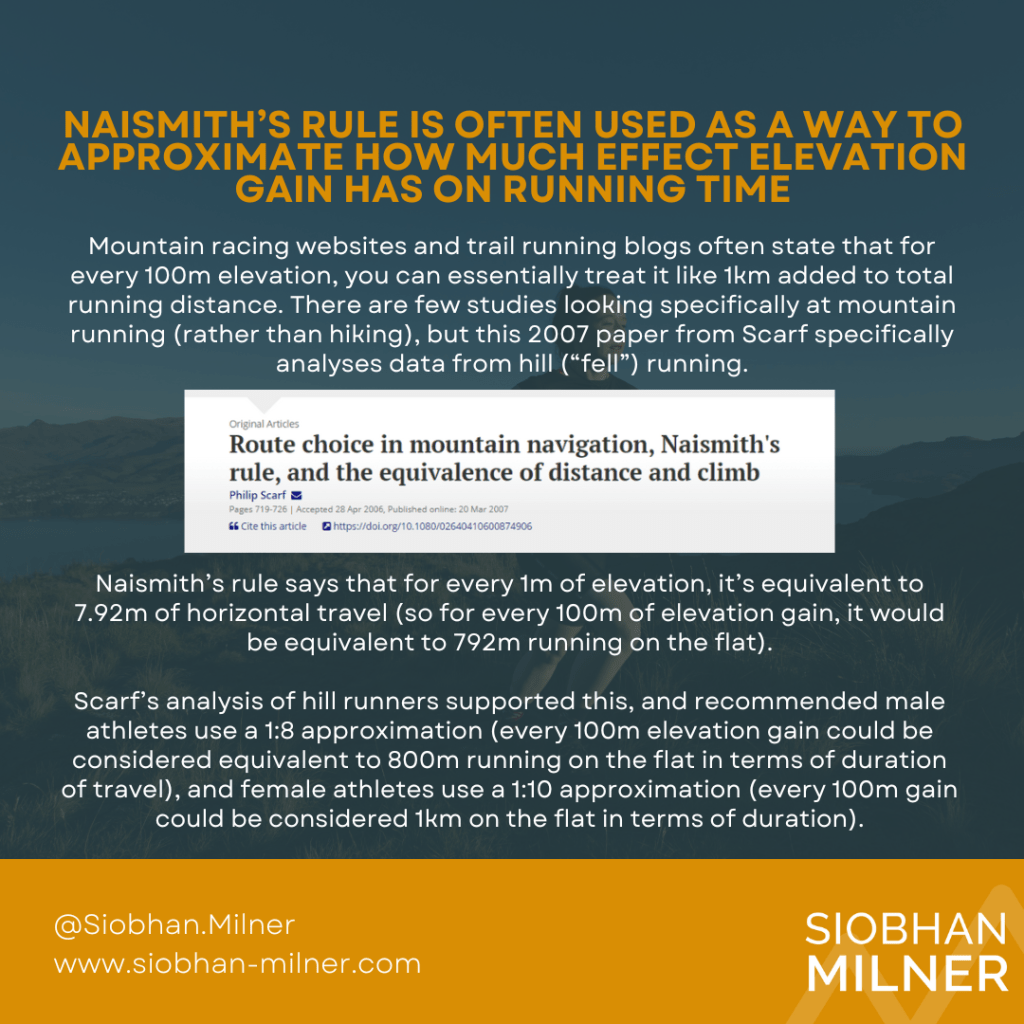
Naismith’s Rule is often used as a way to approximate how much effect elevation gain has on running time. Mountain racing websites and trail running blogs often state that for every 100m elevation, you can essentially treat it like 1km added to total running distance. There are few studies looking specifically at mountain running (rather than hiking), but this 2007 paper from Scarf specifically analyses data from hill (“fell”) running.
Naismith’s rule says that for every 1m of elevation, it’s equivalent to 7.92m of horizontal travel (so for every 100m of elevation gain, it would be equivalent to 792m running on the flat).
Scarf’s analysis of hill runners supported this, and recommended male athletes use a 1:8 approximation (every 100m elevation gain could be considered equivalent to 800m running on the flat in terms of duration of travel), and female athletes use a 1:10 approximation (every 100m gain could be considered 1km on the flat in terms of duration). Again – this is guideline, not a rule, and fitness and technical experience come into play here hugely.
But the bottom line is… If you’re used to running on the flat, prepare to be much slower on the hills.
*Especially* when you’re running off-road on surfaces that may not be paved or stable, and/or navigating yourself. (Unsurprisingly, the findings of this paper contrasted with findings comparing Naismith’s rule to treadmill running on an incline, which lacks these significantly more challenging aspects of outdoor mountain running).
When I’m preparing to run very steep hills back home, I usually plan for runs to take 1.5 – 2x as long as they would on the flat. I plan my weekly mileage in the build up phase accordingly.


 Siobhan Milner